
Reflection in Geometry: Rules, Formulas & Reflection Calculator Guide
Master geometric reflections step-by-step. Learn reflection formulas for axes and custom lines, rules for coordinates and shapes, and how to use an online reflection calculator.
Whether you are solving a high school coordinate geometry problem, programming a 2D rendering engine, or trying to understand how light bounces off an inclined plane, reflections are one of the most fundamental concepts in mathematics. Yet, coordinate reflections are surprisingly prone to simple arithmetic errors — misplaced negative signs, swapped coordinates, or botched perpendicular bisector slopes.
That is why so many students, educators, and engineers reach for a reflection calculator, a geometry reflector, or a specialized transformation reflection calculator. Whether you're searching for a quick check on your homework or accidentally typed "reflection caculator" into your browser late at night, having a rock-solid grasp of the underlying principles makes all the difference.
In this comprehensive guide, we break down how to do reflection in geometry, explore the fundamental reflection geometry rules, work through every primary reflection geometry formula, and demonstrate how to use an interactive reflection calculator math tool to verify your answers instantly.
What Is Reflection in Geometry? The Reflective Property Explained
In Euclidean geometry, a reflection is an isometric transformation (or rigid motion). An isometry preserves distances, angles, perimeter, and area. When you reflect a geometric figure across a given line — known as the line of reflection or mirror line — the resulting image is congruent to the original pre-image.
The defining characteristic of this transformation is the reflective property geometry:
- Every point on the original object and its corresponding point on the reflected image are at the exact same perpendicular distance from the mirror line.
- The mirror line serves as the perpendicular bisector of the line segment connecting any original point $P$ to its reflected counterpart $P'$.
- If a point lies directly on the mirror line, it remains entirely fixed (its reflection is itself).
- Reflection reverses orientation (lateral inversion). If you trace a triangle's vertices in clockwise order, its reflected image will proceed counterclockwise.
When you need to calculate reflection point values across arbitrary lines, you can work through the algebra by hand or enter multiple coordinates into our free reflection calculator to generate both coordinate tables and visual plots automatically.
Core Reflection Geometry Rules: Standard Axes and Diagonal Lines
In coordinate geometry, the simplest and most common reflections occur across the primary coordinate axes and basic $45^{\circ}$ diagonals. Memorizing these core reflection geometry rules will solve the vast majority of classroom problems.
1. Reflection Across the x-Axis (Line $y = 0$)
When you reflect a point across the horizontal x-axis, its horizontal position does not move, but its vertical position flips across zero:
- Formula: $(x, y) \to (x, -y)$
- Example: The point $(3, 4)$ reflects across the x-axis to $(3, -4)$.
- Tool tip: If you are using an axis reflection calculator or an auto reflect on x axis calculator, the x-value stays intact while the y-value negates.
2. Reflection Across the y-Axis (Line $x = 0$)
When reflecting across the vertical y-axis, the vertical position remains unchanged, while the horizontal coordinate negates:
- Formula: $(x, y) \to (-x, y)$
- Example: The point $(-4, 7)$ reflects across the y-axis to $(4, 7)$.
- Tool tip: In a dedicated reflection calculator y module, this operation swaps the sign of every x-coordinate.
3. Reflection Across the Line $y = x$
The line $y = x$ runs diagonally from the bottom-left to top-right at $45^{\circ}$. Reflecting across this line interchanges the roles of $x$ and $y$:
- Formula: $(x, y) \to (y, x)$
- Example: The point $(2, 8)$ reflects across $y = x$ to $(8, 2)$.
- Mathematical significance: In precalculus and algebra, reflecting the graph of a function across $y = x$ produces its inverse relation $f^{-1}(x)$.
4. Reflection Across the Line $y = -x$
The anti-diagonal line $y = -x$ slopes downward from top-left to bottom-right. Reflecting across it swaps and negates both coordinates:
- Formula: $(x, y) \to (-y, -x)$
- Example: The point $(3, -5)$ reflects across $y = -x$ to $(5, -3)$.
5. Reflection Across Horizontal Lines ($y = k$)
What if the line of reflection is not the axis itself, but a horizontal line like $y = 2$ or $y = -3$? This is where searches like reflection across y 2 calculator come from:
- Formula: $(x, y) \to (x, 2k - y)$
- Step-by-step example: Suppose you reflect $(5, 8)$ across the line $y = 2$.
1. The x-coordinate remains unchanged: $x' = 5$. 2. The distance from $y = 8$ to $y = 2$ is $8 - 2 = 6$ units above the line. 3. The reflected y-value must be 6 units below the line: $2 - 6 = -4$. 4. Using the formula: $y' = 2(2) - 8 = 4 - 8 = -4$. 5. The reflected coordinate is $(5, -4)$.
6. Reflection Across Vertical Lines ($x = h$)
Similarly, for any vertical line $x = h$:
- Formula: $(x, y) \to (2h - x, y)$
- Example: Reflecting $(-1, 4)$ across $x = 3$ gives $x' = 2(3) - (-1) = 6 + 1 = 7$, yielding $(7, 4)$.
The General Reflection Geometry Formula: Any Straight Line ($ax + by + c = 0$)
While axis reflections are straightforward, reflecting a point across an arbitrary slanted line — such as $y = 2x + 1$ or $3x - 4y + 5 = 0$ — requires a more generalized reflection geometry formula.
Every straight line in a 2D plane can be written in standard linear form:
$ax + by + c = 0$
For example, to reflect across $y = 2x + 1$, rearrange it into standard form: $2x - y + 1 = 0$, where $a = 2$, $b = -1$, and $c = 1$.
The Projection Formula
To find the reflected point $(x', y')$ of any starting point $(x, y)$, calculate the projection scalar $t$:
$t = \frac{ax + by + c}{a^2 + b^2}$
Once $t$ is determined, the coordinates of the reflected point are:
- $x' = x - 2at$
- $y' = y - 2bt$
Step-by-Step Worked Example
Let's reflect the point $P(3, 4)$ across the line $2x - y + 1 = 0$:
- Identify the coefficients: $a = 2$, $b = -1$, $c = 1$. The point coordinates are $x = 3$, $y = 4$.
- Compute the denominator: $a^2 + b^2 = 2^2 + (-1)^2 = 4 + 1 = 5$.
- Compute the numerator: $ax + by + c = 2(3) + (-1)(4) + 1 = 6 - 4 + 1 = 3$.
- Calculate $t$: $t = \frac{3}{5} = 0.6$.
- Calculate $x'$: $x' = 3 - 2(2)(0.6) = 3 - 2.4 = 0.6$ (or $\frac{3}{5}$).
- Calculate $y'$: $y' = 4 - 2(-1)(0.6) = 4 + 1.2 = 5.2$ (or $\frac{26}{5}$).
The reflected point is $P'(0.6, 5.2)$.
Working through these calculations manually is slow and error-prone, particularly when fractions are involved. This is precisely where an equation of line of reflection calculator, a reflect point over line calculator, or an online reflection over a line calculator becomes indispensable for students and professionals alike.
How to Do Reflection in Geometry for Shapes and Polygons
When dealing with a polygon — such as a triangle, quadrilateral, or pentagon — students often wonder how to do reflection math for an entire figure. The secret is simple: reflect the figure vertex by vertex.
Whether you use a triangle reflection calculator, a shape reflection calculator, or a figure reflection calculator, the procedure to calculate reflected polygon coordinates follows three systematic steps:
- List the coordinates of every vertex: For a triangle $\triangle ABC$, record $(x_A, y_A)$, $(x_B, y_B)$, and $(x_C, y_C)$.
- Apply the reflection formula to each vertex individually: Compute $A'$, $B'$, and $C'$.
- Connect the reflected vertices in order: Draw the line segments $A'B'$, $B'C'$, and $C'A'$ to complete the reflected figure.
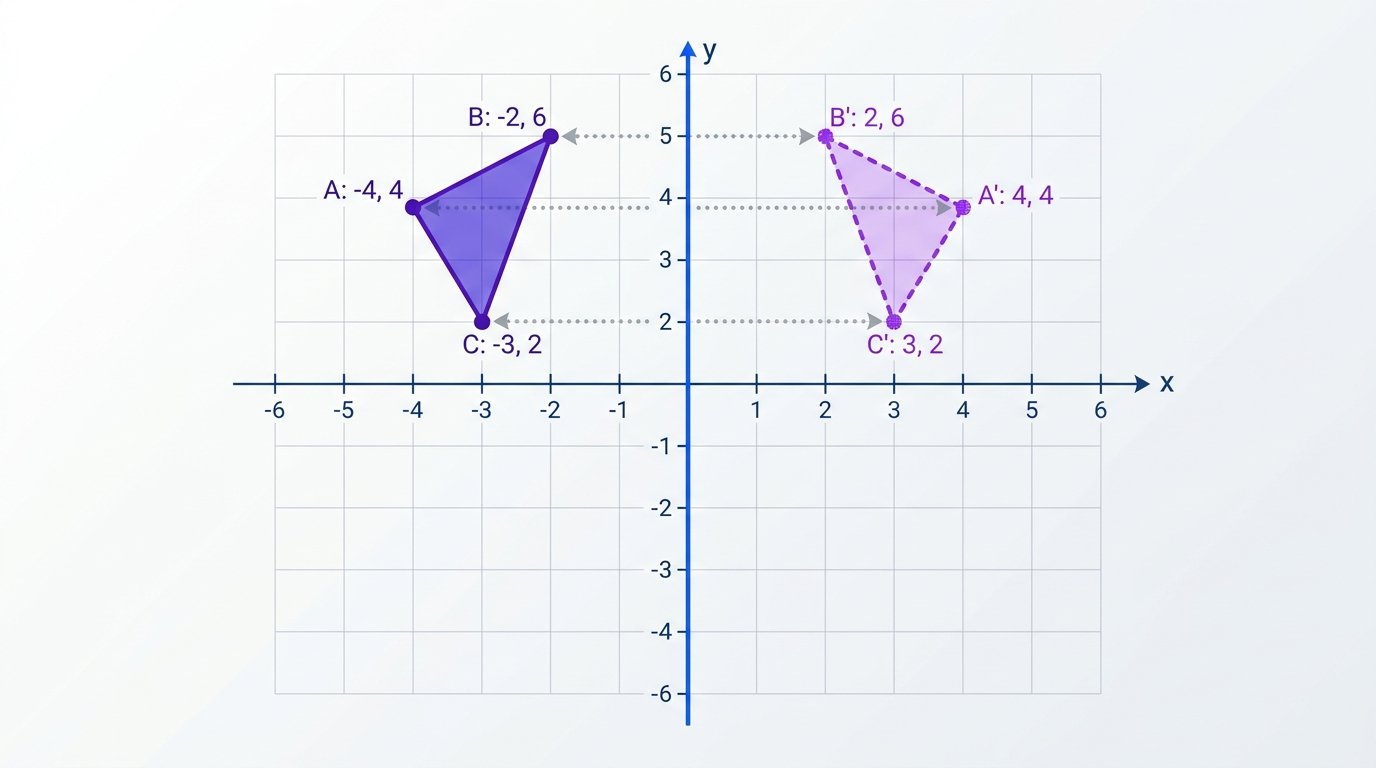
Worked Example: Reflecting a Triangle Across the y-Axis
Consider $\triangle ABC$ with vertices:
- $A(-4, 4)$
- $B(-2, 6)$
- $C(-3, 2)$
Reflecting across the vertical y-axis ($x = 0$) negates each x-coordinate while preserving y:
- $A(-4, 4) \to A'(4, 4)$
- $B(-2, 6) \to B'(2, 6)$
- $C(-3, 2) \to C'(3, 2)$
Notice that the side lengths and angle measures of $\triangle A'B'C'$ remain exactly identical to $\triangle ABC$. However, the orientation is laterally flipped. You can enter all three vertices directly into our reflection calculator separated by newlines to see the coordinates and a clean visual diagram side-by-side.
How to Find the Line of Reflection Methodically
In many geometry exam problems, the question is inverted: you are given the pre-image and the reflected image, and asked to find the line of reflection.
If you don't have access to a find the line of reflection calculator or want to understand the methodical proof behind it, follow this foolproof algebraic process:
- Pick any pair of corresponding points: Take pre-image point $P(x_1, y_1)$ and its image $P'(x_2, y_2)$.
- Find the midpoint $M$: Because the mirror line is an equidistant perpendicular bisector, it must pass through the midpoint between $P$ and $P'$:
$$M = \left(\frac{x_1 + x_2}{2}, \frac{y_1 + y_2}{2}\right)$$
- Find the slope of segment $PP'$:
$$m_{seg} = \frac{y_2 - y_1}{x_2 - x_1}$$
- Determine the perpendicular slope of the mirror line: Two perpendicular lines have slopes that are negative reciprocals ($m_1 \cdot m_2 = -1$):
$$m_{line} = -\frac{1}{m_{seg}} = -\frac{x_2 - x_1}{y_2 - y_1}$$
- Write the equation in point-slope form: Using midpoint $M(x_M, y_M)$ and slope $m_{line}$:
$$y - y_M = m_{line}(x - x_M)$$
Example: Finding the Mirror Line
Suppose $P(1, 5)$ reflects to $P'(5, 1)$.
- Midpoint: $M = \left(\frac{1+5}{2}, \frac{5+1}{2}\right) = (3, 3)$.
- Segment slope: $m_{seg} = \frac{1 - 5}{5 - 1} = \frac{-4}{4} = -1$.
- Mirror line slope: $m_{line} = -\frac{1}{-1} = 1$.
- Equation: $y - 3 = 1(x - 3) \implies y = x$.
The line of reflection is $y = x$. This systematic technique allows you to determine reflections calculator style without guessing.
Function Reflections in Algebra: Vertical vs. Horizontal
In algebra and precalculus, reflections apply not just to isolated points and polygons, but to entire curves and mathematical functions. If you are using a function reflection calculator, a reflecting functions calculator, or graphing transformations on a reflection graphing calculator, two core transformation rules apply:
1. Vertical Reflection: $y = -f(x)$
When you place a negative sign in front of the entire function, every output (y-value) is multiplied by $-1$. This reflects the graph vertically across the x-axis:
- If $f(x) = x^2$, then $g(x) = -x^2$ opens downward instead of upward.
- If $f(x) = |x|$, then $g(x) = -|x|$ acts as an inverted absolute value function (what some searchers call an absolute value reflection finder).
2. Horizontal Reflection: $y = f(-x)$
When the input variable $x$ itself is negated inside the function, every input is flipped across the y-axis:
- If $f(x) = \sqrt{x}$, then $g(x) = \sqrt{-x}$ exists only for non-positive values of $x$, extending to the left instead of the right.
- For an even function where $f(-x) = f(x)$ (like $y = x^2$ or $y = \cos(x)$), a horizontal reflection leaves the graph completely unchanged due to its intrinsic line symmetry.
Reflections Beyond 2D Coordinates: 3D and Point Reflections
Geometric reflections are not restricted to two dimensions or straight lines:
Point Reflections (Reflection Through a Point)
Reflecting a point $P(x, y)$ through a central point $(x_0, y_0)$ — often handled by a mirror point calculator or reflect a point over a point calculator — yields: $$(x', y') = (2x_0 - x, 2y_0 - y)$$ Interestingly, in two-dimensional space, a reflection through a point is geometrically identical to a $180^{\circ}$ rotation around that center point. If you want to explore rotational transformations, check out our companion rotation calculator.
3D Plane Reflections
In three dimensions, an object reflects across a plane of reflection ($ax + by + cz + d = 0$). A 3d reflection calculator uses an extended version of the 2D projection formula: $$t = \frac{ax + by + cz + d}{a^2 + b^2 + c^2}$$ $$x' = x - 2at, \quad y' = y - 2bt, \quad z' = z - 2ct$$ This formula is widely used in 3D computer graphics, CAD modeling, and robotics ray-tracing.
Physical Reflections: Optics, Light, and Sound
It is worth noting that "reflection" also carries deep meaning in physics. While coordinate reflections deal with points on a grid, physical reflections deal with waves and rays bouncing off surfaces.
- The Law of Reflection: When light hits a reflective surface, the angle of incidence equals the angle of reflection:
$$\theta_i = \theta_r$$ Both angles are measured relative to the normal (perpendicular) line to the surface. Tools like a law of reflection calculator, light reflection calculator, or angle of reflection calculator solve for these ray paths in optical systems.
- Acoustics & First Reflections: In sound design and studio engineering, a first reflection calculator calculates the exact boundary locations on walls, ceilings, and floors where sound waves first bounce between speakers and listener ears, helping technicians place acoustic absorption panels.
Tool Comparison: Convert & Count vs. GeoGebra & Desmos
When graphing reflections, students and practitioners often turn to different digital tools:
- GeoGebra: Powerful for dynamic geometry, but many users encounter the frustrating "can't use reflect tool in geogebra" issue when they click out of order (you must create the mirror line first, select the reflect tool, select the object, and then click the line).
- Desmos: Excellent for algebraic function plotting, but setting up arbitrary oblique line reflections of multi-point polygons requires custom matrix sliders or parametric equations.
- Convert & Count Reflection Calculator: Built specifically for instant clarity. You simply type or paste coordinate pairs, select an axis or input line coefficients ($ax + by + c = 0$), and click Calculate. You get the reflected coordinates in an organized table, the exact algebraic working, and a clean visual diagram without having to configure software or download apps.
Common Mistakes to Avoid in Reflection Math
Even experienced mathematicians occasionally trip up on basic reflection calculations. Here are the most frequent pitfalls to avoid:
- Mixing up x-axis and y-axis rules: Remember that reflecting over the x-axis changes the y-coordinate $(x, -y)$, while reflecting over the y-axis changes the x-coordinate $(-x, y)$.
- Confusing reflection across $y = k$ with simple negation: Reflecting $(3, 5)$ across $y = 2$ does not give $(3, -5)$; it gives $(3, -1)$ because the distance from the line ($3$ units) must be subtracted from $y = 2$.
- Forgetting to square coefficients in the general formula: In $t = \frac{ax+by+c}{a^2+b^2}$, remember that the denominator is $a^2 + b^2$, not $\sqrt{a^2 + b^2}$.
- Treating point reflections as line reflections: Reflecting through the origin $(0, 0)$ flips both signs $(-x, -y)$, which is a $180^{\circ}$ rotation, not a single line reflection.
Quick Summary & Cheat Sheet
To keep these formulas handy for your next assignment or project, here is a quick recap:
- x-axis ($y = 0$): $(x, y) \to (x, -y)$
- y-axis ($x = 0$): $(x, y) \to (-x, y)$
- Line $y = x$: $(x, y) \to (y, x)$
- Line $y = -x$: $(x, y) \to (-y, -x)$
- Horizontal line $y = k$: $(x, y) \to (x, 2k - y)$
- Vertical line $x = h$: $(x, y) \to (2h - x, y)$
- General line $ax + by + c = 0$: $t = \frac{ax + by + c}{a^2 + b^2} \implies (x - 2at, y - 2bt)$
- Point reflection through $(x_0, y_0)$: $(x, y) \to (2x_0 - x, 2y_0 - y)$
Ready to verify your points or test a custom line? Try our free reflection calculator to get instant coordinates, step-by-step working, and graphical plots in seconds.