
The Ultimate Steps to Miles Conversion Guide: Pacing, Stride Length & Distance Charts
Everything you need to convert walking and running steps to miles — complete stride length formulas, cadence metrics, and quick reference distance charts from 3,000 to 25,000 steps.
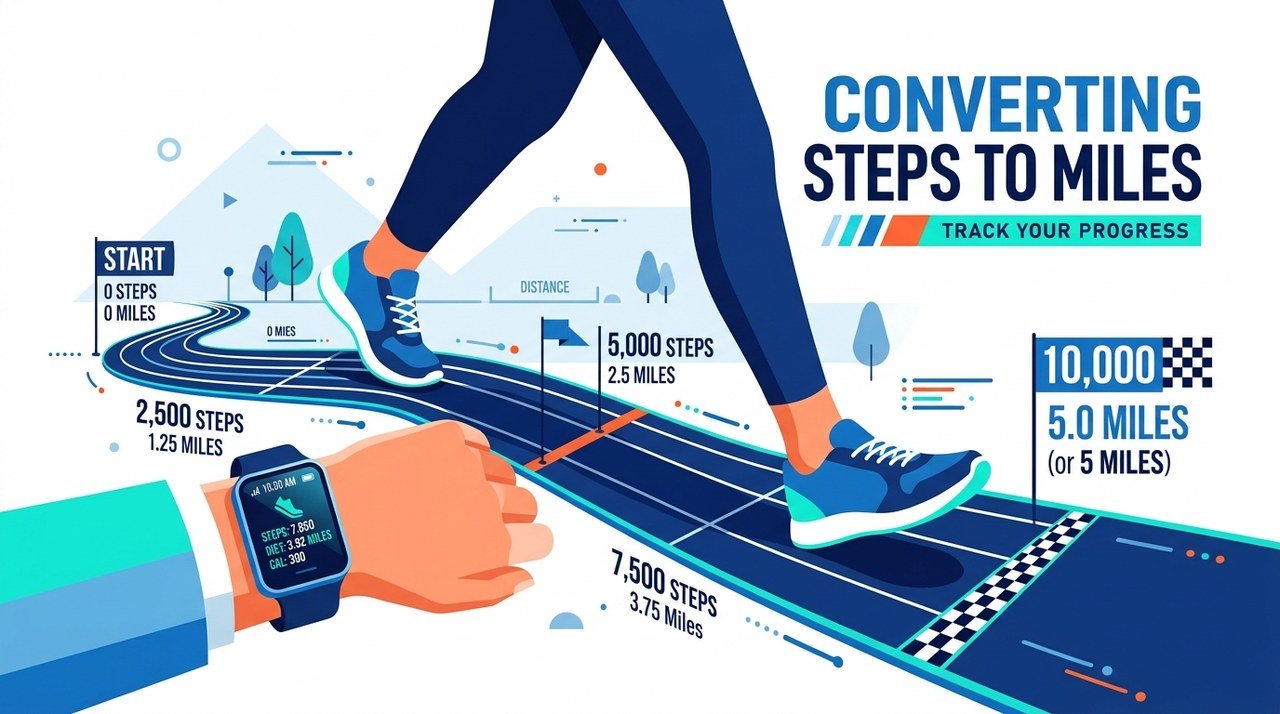
Whether you check your smartwatch before bed, glance at your smartphone during a lunch break stroll, or train for an endurance event, step counts have become the universal currency of modern physical fitness. Yet looking at a round number like 6,000, 10,000, or 20,000 steps on a digital screen often leaves you with an immediate practical question: how many miles did I actually walk?
The relationship between daily footfalls and geographical distance is not a rigid one-size-fits-all formula. Because every human body possesses a unique limb length, walking velocity, and stride geometry, a person who is 5 feet 2 inches tall will cover a noticeably different distance taking 10,000 steps than someone who is 6 feet 3 inches. Furthermore, whether you stroll leisurely through a grocery aisle, power-walk up an incline, or jog across town substantially changes your stride dynamics.
In this comprehensive master guide, we break down the definitive mathematics of converting steps to miles. We provide height-calibrated stride formulas, examine every major step milestone from 3,000 to 25,000 steps, supply an exhaustive conversion reference table, evaluate caloric burn, and explain how to use our interactive Step Rate Cadence Calculator to optimize your daily training.
The General Rule of Thumb: How Many Steps Are in a Mile?
In general fitness and public health literature, the most widely accepted standard rule of thumb is:
1 Mile ≈ 2,000 to 2,500 Walking Steps
For an average adult walking at a moderate, steady pace (approximately 2.8 to 3.2 miles per hour):
- An average stride length is roughly 2.1 to 2.5 feet (25 to 30 inches).
- Since one mile equals exactly 5,280 feet, dividing 5,280 feet by an average stride of 2.5 feet yields 2,112 steps per mile.
- Dividing 5,280 feet by a shorter stride of 2.1 feet yields 2,514 steps per mile.
- For quick mental math, calculating 2,000 steps per mile provides a reliable, conservative baseline for tall individuals or brisk walkers, while 2,200 to 2,400 steps per mile is typical for average-height individuals and casual walkers.
Step Length vs. Stride Length: Biomechanical Definitions
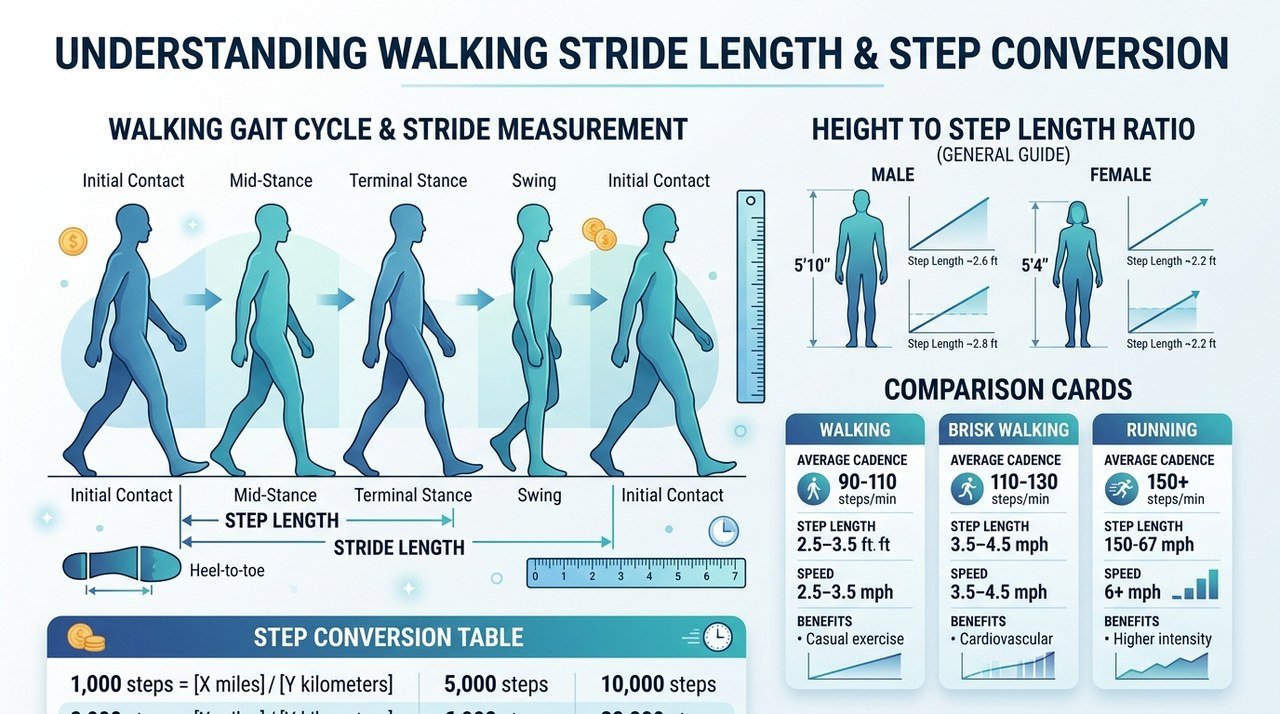
Before applying mathematical conversions, it is critical to clarify a frequent point of confusion in biomechanics and pedometer tracking: the difference between step length and stride length.
- Step Length: The distance measured from the heel strike of one foot to the heel strike of the opposite foot. When your activity tracker logs "+1 step," it records a single step length.
- Stride Length: In clinical gait analysis, a full stride represents one complete gait cycle — the distance from the heel strike of your right foot to the next heel strike of the same right foot (two consecutive steps).
In consumer fitness terminology, many smartwatch manufacturers use the terms interchangeably or define "stride length" as the distance per single step. Throughout this guide, whenever we discuss converting step counts to miles, we refer strictly to single step length.
How Height Determines Your Step Length (The Scientific Formula)
Your leg length is the primary anatomical determinant of your step length. In human anthropometry and exercise science, extensive kinematic research has established that an individual's natural walking step length is approximately 41.3% to 43% of their total body height for women, and 41.5% to 45% for men.
To calculate your personalized step length with high precision, use the standard anthropometric ratio:
Step Length (inches) = Height (inches) × 0.415
Once you determine your step length in inches, you can calculate your exact step-to-mile factor:
- Convert your height into inches (e.g., 5 feet 9 inches = 69 inches).
- Multiply your height by 0.415: 69 × 0.415 = 28.635 inches per step.
- Convert step length into feet: 28.635 ÷ 12 = 2.386 feet per step.
- Divide feet in a mile by feet per step: 5,280 ÷ 2.386 = 2,213 steps per mile.
- To find your total miles: Total Miles = Total Steps ÷ Steps Per Mile.
Height-to-Step Conversion Reference Table
The table below illustrates how human height directly impacts steps per mile and total distance covered across common heights:
- Height: 5'0" (60 in) | Step Length: 24.9 in (2.08 ft) | Steps Per Mile: 2,544 steps | 10k Steps Distance: 3.93 miles
- Height: 5'2" (62 in) | Step Length: 25.7 in (2.14 ft) | Steps Per Mile: 2,464 steps | 10k Steps Distance: 4.06 miles
- Height: 5'4" (64 in) | Step Length: 26.6 in (2.21 ft) | Steps Per Mile: 2,386 steps | 10k Steps Distance: 4.19 miles
- Height: 5'6" (66 in) | Step Length: 27.4 in (2.28 ft) | Steps Per Mile: 2,317 steps | 10k Steps Distance: 4.32 miles
- Height: 5'8" (68 in) | Step Length: 28.2 in (2.35 ft) | Steps Per Mile: 2,247 steps | 10k Steps Distance: 4.45 miles
- Height: 5'10" (70 in) | Step Length: 29.1 in (2.42 ft) | Steps Per Mile: 2,181 steps | 10k Steps Distance: 4.58 miles
- Height: 6'0" (72 in) | Step Length: 29.9 in (2.49 ft) | Steps Per Mile: 2,120 steps | 10k Steps Distance: 4.72 miles
- Height: 6'2" (74 in) | Step Length: 30.7 in (2.56 ft) | Steps Per Mile: 2,063 steps | 10k Steps Distance: 4.85 miles
- Height: 6'4" (76 in) | Step Length: 31.5 in (2.63 ft) | Steps Per Mile: 2,008 steps | 10k Steps Distance: 4.98 miles
Milestone Step Counts to Miles: Deep Breakdown
Let us examine the most frequently searched step benchmarks, exploring their practical distance, walking duration, and physical fitness implications.
3,000 to 4,000 Steps to Miles
Accumulating 3,000 steps equals approximately 1.3 to 1.5 miles (2.1 to 2.4 kilometers). Reaching 4,000 steps to miles translates to approximately 1.75 to 2.0 miles (2.8 to 3.2 km).
In public health categorizations, individuals recording fewer than 5,000 steps daily are classified as having a sedentary lifestyle. However, taking a dedicated 30-minute neighborhood walk contributes roughly 3,000 to 3,500 steps, immediately transitioning you toward moderate cardiovascular activity.
5,000 to 6,000 Steps to Miles
Logging 5,000 steps to miles yields approximately 2.2 to 2.5 miles (3.5 to 4.0 km). Meanwhile, 6,000 steps to miles — one of the most common daily tallies for desk workers with moderate daily movement — equals 2.6 to 3.0 miles (4.2 to 4.8 km).
Studies published in major medical journals like The Lancet Public Health demonstrate that the steep drop in all-cause mortality begins right around the 6,000 to 7,000 step threshold for older adults. If your tracker shows 6,000 steps, you have walked roughly the equivalent of 12 city blocks back and forth or 12 laps around a standard 400-meter track.
8,000 to 9,000 Steps to Miles
Hitting 8,000 steps to miles produces approximately 3.5 to 4.0 miles (5.6 to 6.4 km), and 9,000 steps equals approximately 3.9 to 4.5 miles (6.3 to 7.2 km).
For individuals looking for the optimal balance between time commitment and longevity, 8,000 steps represents the "sweet spot" identified in recent epidemiological research. An 8,000-step day requires about 75 to 90 minutes of total movement throughout the day and burns approximately 300 to 450 active calories.
10,000 Steps to Miles (The Classic Benchmark)
The iconic 10,000 steps goal equates to approximately 4.2 to 5.0 miles (6.8 to 8.0 km), depending on your stride length. At an average cadence of 100 steps per minute, logging 10,000 steps takes about 1 hour and 40 minutes of total moving time.
While the 10,000-step target originally originated as a marketing campaign for the 1964 Tokyo Olympics (the Japanese Manpo-kei pedometer, meaning "10,000-steps meter"), modern clinical trials consistently validate it as a superb benchmark for weight maintenance, insulin sensitivity, and blood pressure control.
11,000 to 12,000 Steps to Miles
Logging 11,000 steps to miles corresponds to 4.8 to 5.5 miles (7.7 to 8.9 km). Stepping up to 12,000 steps to miles yields 5.2 to 6.0 miles (8.4 to 9.7 km).
Accumulating 12,000 steps daily puts you firmly in the "highly active" lifestyle bracket. It often requires intentional lifestyle adaptations, such as an under-desk walking pad, walking during conference calls, or an evening post-dinner stroll.
15,000 Steps to Miles (15k Steps)
Reaching 15,000 steps miles (or 15k steps to miles) equals approximately 6.5 to 7.5 miles (10.5 to 12.1 km). This is a substantial distance — roughly equivalent to walking more than a quarter of a marathon every single day.
Hospital nurses, warehouse fulfillment staff, postal delivery carriers, and avid hikers frequently log 15,000 steps during normal working shifts, resulting in daily active energy expenditure exceeding 600 to 800 kcal.
18,000 to 20,000 Steps to Miles (20k Steps)
Recording 18,000 steps in miles translates to 7.8 to 9.0 miles (12.6 to 14.5 km). When you reach how many miles is 20,000 steps (also searched as 20k steps to miles), you are covering an impressive 8.7 to 10.0 miles (14.0 to 16.1 km).
Walking 20,000 steps burns between 800 and 1,200 calories depending on body weight. Sustaining 20,000 steps requires approximately 3 to 3.5 hours of steady walking, typically seen during long sightseeing holidays, half-marathon footraces, or intensive trekking.
22,000 to 25,000 Steps to Miles
Hitting 22,000 steps to miles equals 9.5 to 11.0 miles (15.3 to 17.7 km). The colossal milestone of 25,000 steps to miles represents 10.8 to 12.5 miles (17.4 to 20.1 km).
At 25,000 steps, you are within striking distance of a full 13.1-mile half marathon or completing nearly half of the 26.2-mile marathon distance purely on foot.
The Master Conversion Table: Steps, Miles, Kilometers & Time
Below is a quick reference conversion matrix computed for an average adult with a standard 2.3-foot stride (2,300 steps per mile at a moderate 3.0 mph walking pace):
- 1,000 steps: 0.43 miles | 0.70 km | ~10 mins walk | ~40-50 kcal
- 2,000 steps: 0.87 miles | 1.40 km | ~20 mins walk | ~80-100 kcal
- 3,000 steps: 1.30 miles | 2.10 km | ~30 mins walk | ~120-150 kcal
- 4,000 steps: 1.74 miles | 2.80 km | ~40 mins walk | ~160-200 kcal
- 5,000 steps: 2.17 miles | 3.50 km | ~50 mins walk | ~200-250 kcal
- 6,000 steps: 2.61 miles | 4.20 km | ~60 mins walk | ~240-300 kcal
- 7,000 steps: 3.04 miles | 4.90 km | ~70 mins walk | ~280-350 kcal
- 8,000 steps: 3.48 miles | 5.60 km | ~80 mins walk | ~320-400 kcal
- 9,000 steps: 3.91 miles | 6.30 km | ~90 mins walk | ~360-450 kcal
- 10,000 steps: 4.35 miles | 7.00 km | ~100 mins walk | ~400-500 kcal
- 11,000 steps: 4.78 miles | 7.70 km | ~110 mins walk | ~440-550 kcal
- 12,000 steps: 5.22 miles | 8.40 km | ~120 mins walk | ~480-600 kcal
- 15,000 steps: 6.52 miles | 10.50 km | ~150 mins walk | ~600-750 kcal
- 18,000 steps: 7.83 miles | 12.60 km | ~180 mins walk | ~720-900 kcal
- 20,000 steps: 8.70 miles | 14.00 km | ~200 mins walk | ~800-1,000 kcal
- 22,000 steps: 9.57 miles | 15.40 km | ~220 mins walk | ~880-1,100 kcal
- 25,000 steps: 10.87 miles | 17.50 km | ~250 mins walk | ~1,000-1,250 kcal
Walking vs. Running: How Cadence and Speed Alter Step Count
When you transition from walking to jogging or running, your biomechanics undergo an immediate transformation known as the "walk-to-run transition" (typically occurring around 4.5 to 5.0 mph):
- Walking Stride: When walking, at least one foot remains in contact with the ground at all times (double support phase). Stride length is shorter, averaging 2.1 to 2.5 feet, yielding roughly 2,100 to 2,500 steps per mile.
- Running Stride: When running, you enter a "flight phase" where both feet leave the ground simultaneously. Forward momentum, hip extension, and aerial travel cause your step length to lengthen dramatically to 3.0 to 4.2 feet (36 to 50 inches).
- Steps in a Running Mile: Because each running stride covers far more distance, a runner takes significantly fewer steps to complete a mile — typically between 1,400 and 1,700 steps per mile!
If you run a 5K race (3.1 miles), you will log approximately 4,500 to 5,200 steps. If you walk that exact same 5K course, you will log approximately 6,800 to 7,500 steps! The physical distance is identical, but your cadence and stride length create a substantial discrepancy in step count.
To analyze your exact running or walking cadence in steps per minute (SPM), you can test your numbers directly with our dedicated Step Rate Cadence Calculator, which calculates turnover rate and stride frequency in real time.
Calories Burned Per Step and Per Mile
How many calories are burned across different step totals? While exact caloric expenditure depends heavily on your body mass, metabolic efficiency, and walking speed, the exercise science rule of thumb is:
1 Mile of Walking ≈ 80 to 100 Calories Burned (for a 140 to 180-pound adult)
Dividing that by ~2,200 steps per mile reveals that each walking step burns approximately 0.04 to 0.05 calories. Thus:
- 5,000 steps: Burns ~200 to 250 kcal (equivalent to a standard energy bar).
- 10,000 steps: Burns ~400 to 500 kcal (equivalent to a complete light meal).
- 15,000 steps: Burns ~600 to 750 kcal.
- 20,000 steps: Burns ~800 to 1,000 kcal.
Walking uphill at a 5% to 10% grade can increase this caloric expenditure by 50% to 100% without increasing your step count, making incline walking one of the most time-efficient cardiovascular workouts available.
Why Your Phone, Smartwatch and GPS Trackers Disagree
Have you ever noticed that your Apple Watch records 10,200 steps while your iPhone in your pocket records 8,900, and a dedicated GPS running app records 4.4 miles while your step conversion suggests 4.1 miles? Here is why tracker discrepancies occur:
- Accelerometer Sensitivity: Wrist-based trackers detect rhythmic wrist swings. Brushing teeth, gesturing during conversations, or chopping vegetables can inadvertently register phantom steps. Conversely, pushing a stroller or grocery cart immobilizes your wrist, causing the tracker to miss thousands of steps.
- GPS vs. Dead Reckoning: GPS calculates direct satellite positioning between coordinates. Step counters use internal accelerometers to guess distance based on an assumed default stride length entered in your profile settings.
- Stride Calibration Errors: If your fitness app assumes a default 2.5-foot stride, but your actual stride is 2.2 feet, your tracker will overestimate your total mileage by over 13% every single day! Calibrating your true step length over a known track distance instantly eliminates this error.
How to Accurately Measure Your Personal Stride Length
If you want exact, error-free step-to-mile conversions, the best technique is to measure your actual stride on a flat surface:
- Find a Known Distance: A standard local running track is ideal (the inside lane is exactly 400 meters, which equals 1,312.3 feet). Alternatively, measure out a 100-foot line with a tape measure.
- Walk at Your Normal Pace: Start walking naturally several paces before the line so you are at full walking rhythm when crossing the start point.
- Count Your Steps: Count every step until you cross the finish mark.
- Apply the Division Formula: Divide total distance in feet by your step count. For example, if you walked 100 feet in 42 steps: 100 ÷ 42 = 2.38 feet per step.
- Calculate Your Steps Per Mile: Divide 5,280 by 2.38: 5,280 ÷ 2.38 = 2,218 steps per mile.
You can then input this exact figure into your wearable device settings to achieve pin-point accurate daily distance logging.
Common Mistakes When Converting Steps to Distance
- Assuming everyone walks the same mile: A 5'1" individual walking 10,000 steps covers roughly 3.9 miles. A 6'2" individual walking the same 10,000 steps covers nearly 4.9 miles — a full mile difference!
- Treating running steps like walking steps: Forgetting that running expands your stride by 40% to 60%, resulting in substantially fewer steps per mile.
- Ignoring terrain and elevation changes: Walking on steep hills, loose sand, or rocky trails naturally shortens your stride, requiring more steps to cover the same geographical distance.
- Relying on uncalibrated smartphone defaults: Most smartphone health apps default to an estimated height if not configured, leading to significant cumulative distance errors over weeks and months.
Frequently Asked Questions (FAQ)
How many miles is 6,000 steps?
For most average adults, 6,000 steps equals approximately 2.6 to 3.0 miles (4.2 to 4.8 km). A taller person with a 2.5-foot stride will cover almost exactly 3.0 miles, while someone shorter with a 2.2-foot stride will cover about 2.6 miles.
How many miles is 20,000 steps?
20,000 steps equals approximately 8.7 to 10.0 miles (14.0 to 16.1 km). Covering 20,000 steps requires roughly 3 to 3.5 hours of continuous walking and burns between 800 and 1,200 calories depending on body weight.
How many miles is 5,000 steps?
5,000 steps equals approximately 2.2 to 2.5 miles (3.5 to 4.0 km). At an average moderate pace of 3 mph, completing 5,000 steps takes about 45 to 50 minutes of walking.
How many miles is 8,000 steps?
8,000 steps equals approximately 3.5 to 4.0 miles (5.6 to 6.4 km). For most adults, 8,000 steps represents the optimal evidence-based threshold for reducing cardiovascular disease and all-cause mortality risk.
How many miles is 12,000 steps?
12,000 steps equals approximately 5.2 to 6.0 miles (8.4 to 9.7 km). Walking 12,000 steps daily puts an individual into the highly active lifestyle category, burning between 480 and 600 active calories.
How many steps is a 5K?
A 5K is 3.107 miles (16,404 feet). If you walk a 5K, it takes approximately 6,800 to 7,500 steps. If you run a 5K, your elongated stride reduces the step count to approximately 4,500 to 5,200 steps.
How many steps is a 10K?
A 10K is 6.214 miles. Walking a 10K requires approximately 13,500 to 15,000 steps, whereas running a 10K requires approximately 9,200 to 10,500 steps.
Can walking 10,000 steps a day help me lose weight?
Yes. Walking 10,000 steps burns approximately 400 to 500 calories daily. Over a full week, that creates a cumulative caloric expenditure of 2,800 to 3,500 kcal — roughly equivalent to one pound of body fat burned, assuming your nutritional caloric intake remains at maintenance.
Summary & Next Steps
Converting your daily step count to miles transforms an abstract digital number into concrete, measurable physical distance. To recap the most essential figures:
- Average conversion: ~2,200 walking steps = 1 mile (~0.45 miles per 1,000 steps).
- Quick benchmarks: 5k steps ≈ 2.3 miles | 6k steps ≈ 2.7 miles | 8k steps ≈ 3.7 miles | 10k steps ≈ 4.5 miles | 20k steps ≈ 9.0 miles.
- Running adjustment: Running cuts steps per mile down to 1,400–1,700 steps due to flight phase stride elongation.
- Personal stride factor: Multiply height in inches by 0.415 to discover your personalized step length.
Ready to dial in your pace, cadence, and distance tracking? Try our free Step Rate Cadence Calculator to measure your exact steps per minute and optimize your daily walking workouts!