
Calories Burned Walking: Formulas for Body Weight, Incline, Pace & Stride Rate
Calculate exactly how many calories you burn walking per mile, minute, and step count using scientific MET equations, incline adjustments, body weight metrics, and terrain factors.

Walking is frequently described as the most natural, accessible, and sustainable form of human physical exercise. Whether you stroll leisurely through your neighborhood, commute on foot through city streets, hike steep trails, or walk your dog every morning, this fundamental movement serves as the bedrock of your daily energy expenditure. Yet, when you set out to track your daily physical activity or optimize your energy balance for fat loss, an essential question immediately emerges: how do you accurately calculate calories burned walking?
Estimating energy expenditure during walking is far more nuanced than reading a single generic number off a fitness tracker. The exact metabolic cost of every step you take depends upon a complex interplay of biomechanical and environmental variables: your total body mass, walking velocity, cadence, stride mechanics, ground gradient (incline vs. flat surface), and even whether you walk solo or stop frequently with a pet. A 130-pound person walking at a casual 2.5 mph pace burns a drastically different amount of energy per mile than a 220-pound person power-walking at 4.0 mph up a 6% incline grade.
In this authoritative guide, we provide the complete scientific framework for estimating your energy expenditure. We break down the clinical Metabolic Equivalent of Task (MET) equations used by exercise physiologists, explore the mathematical physics of human gait, supply comprehensive lookup tables across weights and durations, evaluate the dramatic caloric impact of incline walking, and demonstrate how our interactive Dog Walking Estimated Calories Calculator and Step Rate Cadence Calculator provide precision estimates tailored to your real-world daily routines.
The Biomechanical Physics of Walking: Why Moving Mass Consumes Energy
To understand how a walking calorie calculator computes energy expenditure, it is helpful to first examine the basic biomechanical physics of the human gait. In physics, mechanical work is defined as force applied across a distance:
Work (Joules) = Force (Newtons) × Distance (meters)
When walking on level ground, you are not merely moving forward horizontally. The human bipedal gait operates as an inverted pendulum system. With each step you take, your body’s center of mass rises and falls vertically by approximately 1.5 to 2.5 inches (4 to 6 centimeters), while simultaneously accelerating forward during heel-off and decelerating during heel strike.
This perpetual cycle of mechanical work requires muscular contractions, predominantly from the quadriceps, hamstrings, gluteus medius and maximus, gastrocnemius, and soleus muscles. Each muscular contraction consumes adenosine triphosphate (ATP), which is synthesized through cellular respiration by burning glucose, free fatty acids, and glycogen. Because the mechanical work required to lift and propel your center of mass is directly proportional to the total mass being moved, your body weight is the single largest individual variable determining your caloric expenditure while walking.
The Clinical Standard: Metabolic Equivalent of Task (MET) Formulas
In clinical exercise physiology and public health research, the gold standard methodology for calculating energy expenditure across physical activities is the Metabolic Equivalent of Task (MET) system, maintained in the Compendium of Physical Activities (Ainsworth et al.).
What is a MET?
One MET is defined as the rate of energy expenditure while sitting quietly at complete rest. By scientific convention:
- 1 MET = 1.0 kcal per kilogram of body weight per hour (1.0 kcal/kg/h)
- Equivalently: 1 MET = 3.5 mL of oxygen consumed per kilogram of body weight per minute (3.5 mL O&sub2;/kg/min)
When an activity has a MET score of 3.0, it means your metabolic rate during that activity is exactly three times higher than your baseline resting metabolic rate.
The Universal MET Calorie Formula
To calculate the total kilocalories (kcal) burned during any walking session using a kcal burned walking calculator, exercise scientists utilize the standard formula:
Calories (kcal) = MET × 3.5 × Weight (kg) / 200 × Duration (minutes)
Alternatively, using the direct hourly formulation:
Calories (kcal) = MET × Weight (kg) × Time (hours)
If you measure your weight in pounds (lbs), convert your weight to kilograms first by dividing by 2.20462, or use the imperial shortcut:
Calories (kcal) = MET × 0.0175 × Weight (kg) × Duration (minutes)
Step-by-Step Worked Calculation Example
Let us work through an exact real-world scenario:
- Individual: Weighs 176 pounds (80.0 kg).
- Activity: Brisk neighborhood walk at 3.5 mph (5.6 km/h) on level pavement.
- MET Value: According to the Compendium of Physical Activities, walking briskly at 3.5 mph corresponds to a MET of 4.3.
- Duration: 45 minutes (0.75 hours).
- Calculation:
- Using the minute formula: 4.3 × 3.5 × 80 ÷ 200 × 45 = 6.02 × 45 = 270.9 kcal.
- Using the hourly formula: 4.3 × 80 × 0.75 = 258.0 kcal (the slight variance stems from rounding oxygen conversion factors in standard tables).
In 45 minutes of brisk walking, this individual burns approximately 260 to 270 gross calories.
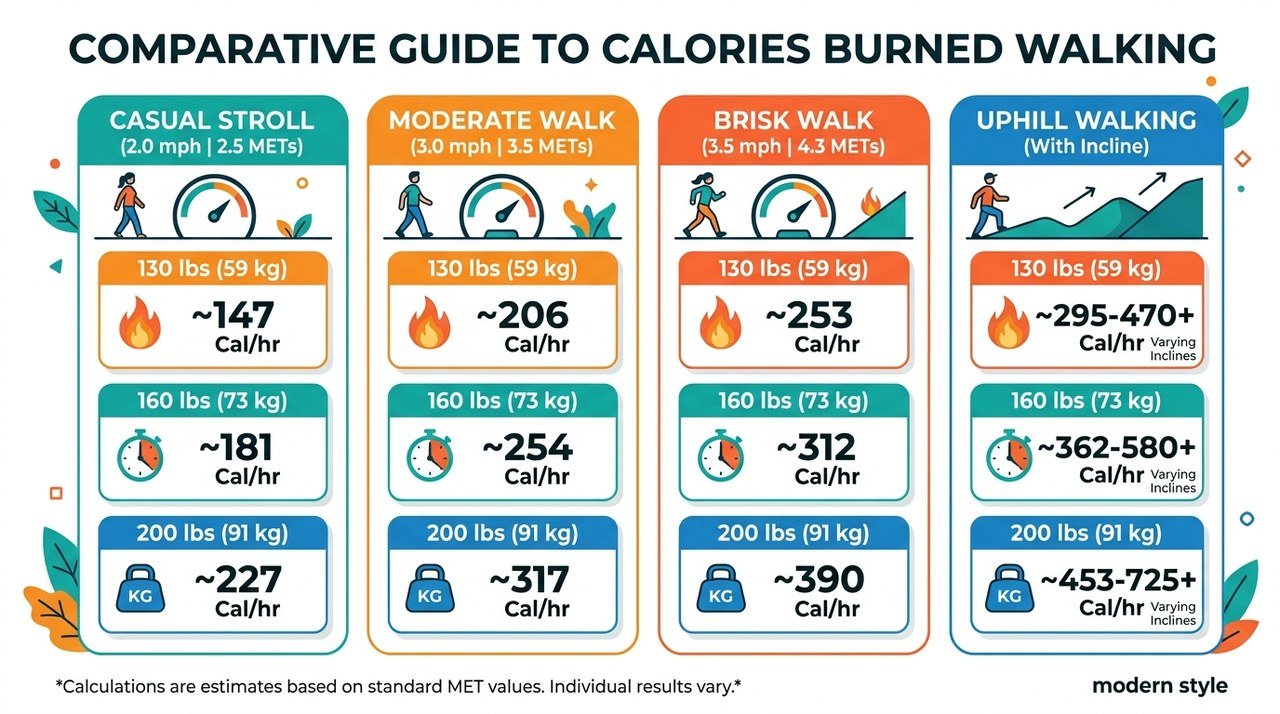
Walking Speed & MET Reference Matrix
Walking velocity exerts an exponential influence on energy expenditure. At very slow speeds, your body operates within a highly efficient mechanical zone. However, as your speed surpasses 3.8 to 4.0 mph, the biomechanical efficiency of walking decreases dramatically, requiring substantial muscular effort to swing the limbs rapidly without transitioning into a jogging gait.
The table below outlines verified MET ratings across different walking speeds and modalities from clinical literature:
- Slow Stroll (< 2.0 mph / 3.2 km/h): 2.0 METs | Leisurely window shopping, slow office pacing.
- Casual Walking (2.5 mph / 4.0 km/h): 2.8 to 3.0 METs | Walking across flat asphalt, walking on a firm trail.
- Moderate Pace (3.0 mph / 4.8 km/h): 3.3 to 3.5 METs | Standard purposeful commute, brisk neighborhood loop.
- Brisk Walking (3.5 mph / 5.6 km/h): 4.3 METs | Noticeable arm swing, elevated breathing, purposeful fitness pace.
- Very Brisk / Fast (4.0 mph / 6.4 km/h): 5.0 METs | Speed-walking, deliberate athletic stride on flat ground.
- Racewalking / Power Walking (4.5+ mph / 7.2+ km/h): 6.8 to 7.0 METs | Vigorous competitive power walking with full hip rotation.
- Walking While Carrying Load (Rucking 15-25 lbs): 5.5 to 7.5 METs | Pavement or packed dirt with weighted tactical pack.
- Hiking Trails with Rolling Hills: 5.3 to 6.5 METs | Natural dirt, uneven roots, and variable modest inclines.
The Impact of Body Weight: The Physics of Moving Mass
One of the most persistent misconceptions among fitness beginners is that walking a mile burns a fixed number of calories (such as "walking a mile always burns 100 calories"). In reality, calories burned walking scales linearly with total body weight.
Consider the caloric cost of walking 1 mile at a standard moderate pace (3.0 mph) across various body weights:
- A 120 lb (54.4 kg) person burns approximately 65 calories per mile.
- A 160 lb (72.6 kg) person burns approximately 87 calories per mile.
- A 200 lb (90.7 kg) person burns approximately 109 calories per mile.
- A 240 lb (108.9 kg) person burns approximately 131 calories per mile.
A 240-pound individual expends more than twice as much energy covering the exact same physical distance as a 120-pound individual. This occurs because the musculoskeletal system must generate double the kinetic force to propel twice the mass forward against gravity and inertia with every single stride. If you are calculating your baseline metabolic needs or tracking your weight, you can pair this with our Body Mass Index (BMI) Calculator to monitor how changing body composition influences your daily caloric burn.
The Power of Incline: How Uphill Walking Multiplies Calorie Burn
If you want to drastically amplify the caloric output of your walking sessions without having to run or place high-impact shock on your knees, ankles, and lumbar spine, incline walking is the ultimate training stimulus.
The Pandolf Equation & Vertical Mechanical Work
When walking on an incline, you are no longer merely moving horizontally; you are actively performing gravitational mechanical work by lifting your body weight vertically:
Vertical Work = Mass × Acceleration due to Gravity ($9.81 ext{ m/s}^2$) × Vertical Height Gained
In military and occupational ergonomics, the renowned Pandolf Equation and the American College of Sports Medicine (ACSM) metabolic equations quantify the oxygen cost ($VO_2$) of walking on an incline:
$VO_2 ext{ (mL/kg/min)} = (0.1 imes S) + (1.8 imes S imes G) + 3.5$
Where:
- $S$ is walking speed in meters per minute (1 mph = 26.8 m/min).
- $G$ is the fractional incline grade (e.g., a 5% grade = 0.05; a 10% grade = 0.10).
- $0.1$ is the oxygen cost of horizontal locomotion per meter.
- $1.8$ is the oxygen cost of vertical lift per meter.
- $3.5$ is resting oxygen consumption ($1 ext{ MET}$).
The Incline Multiplier Breakdown
Notice the enormous coefficient of $1.8$ attached to vertical movement compared to just $0.1$ for horizontal motion! This mathematical reality explains why even modest treadmill inclines dramatically accelerate cardiovascular strain and calorie expenditure:
- 0% Grade (Flat): 1.0x baseline calorie burn (Reference: ~85 kcal/mile for 160 lbs).
- 3% Grade: ~1.35x baseline burn (~115 kcal/mile).
- 6% Grade: ~1.75x baseline burn (~149 kcal/mile).
- 9% Grade: ~2.15x baseline burn (~183 kcal/mile).
- 12% Grade: ~2.55x baseline burn (~217 kcal/mile).
- 15% Grade: ~3.00x baseline burn (~255 kcal/mile).
Walking at 3.0 mph on a 12% to 15% incline (often popularized on social media as the "12-3-30" treadmill workout: 12% incline, 3.0 mph, for 30 minutes) burns approximately as many calories as running at 6.0 mph on flat ground, while generating only a fraction of the joint-impact forces.
Cadence, Stride Length, and Step Count to Calorie Conversion
Most modern fitness enthusiasts track their daily activity through pedometers and smartwatches rather than measured mileages. To bridge the gap between step metrics and energy expenditure, you must evaluate cadence and stride mechanics.
As detailed in our in-depth Steps to Miles Conversion Guide, the average adult takes between 2,000 and 2,500 steps to cover one mile, with an average walking cadence of 90 to 120 steps per minute:
- Casual Strolling: 60 to 80 steps per minute.
- Moderate Aerobic Walking: 95 to 115 steps per minute.
- Brisk Power Walking: 120 to 135 steps per minute.
To compute your exact cadence and stride dynamics, you can consult our dedicated Step Rate Cadence Calculator. Once you determine your personal steps-per-mile factor, you can accurately estimate your caloric expenditure directly from your daily step tally.
The Rule of Thumb for 10,000 Steps
On average, logging 10,000 steps equals approximately 4.2 to 5.0 miles of walking. For a person weighing 160 pounds (72.6 kg), completing 10,000 steps at a moderate pace burns roughly 350 to 450 active calories. For a 200-pound individual, those same 10,000 steps consume approximately 450 to 550 calories.
Dog Walking vs Solo Walking: The Stop-and-Go Metabolic Reality
One of the most frequent real-world walking activities is dog walking. Over 65 million households in the United States own at least one canine companion, making daily walks with dogs a primary source of physical exercise. However, using a generic walking calorie calculator for dog walks often results in significant over- or under-estimations.
Why Dog Walking Differs Metabolically from Solo Walking
When walking alone, humans maintain a continuous, rhythmic, and steady aerobic cadence. In contrast, dog walking introduces unique physiological factors:
- Intermittent Stops and Sniffing Breaks: Dogs frequently stop to explore scents, mark territory, or greet other dogs. These intermittent pauses lower your average velocity and heart rate, reducing the continuous aerobic MET value from 3.5 down to approximately 2.5 to 3.0.
- Leash Resistance and Direction Changes: Walking an energetic, large, or pulling dog (e.g., a Labrador, German Shepherd, or Golden Retriever) requires substantial isometric and core stabilization to manage leash tension, which increases muscular engagement.
- Terrain Traversal: Following a dog off designated paved paths onto uneven grass, dirt, or park trails increases foot stabilization demands and caloric burn.
To accurately capture these specialized variables, use our purpose-built Dog Walking Estimated Calories Calculator, which accounts for canine breed size, leash handling dynamics, and actual moving time versus standing pauses.
Comprehensive Master Reference Tables
The following reference tables allow you to instantly cross-reference your body weight, walking pace, duration, and distance to determine your precise caloric burn.
Table 1: Estimated Calories Burned per Mile by Body Weight & Speed
Calculated for flat, paved terrain across common body weights:
- Body Weight: 120 lbs (54 kg)
- 2.5 mph (Casual): 60 kcal/mile
- 3.0 mph (Moderate): 65 kcal/mile
- 3.5 mph (Brisk): 71 kcal/mile
- 4.0 mph (Power): 79 kcal/mile
- Body Weight: 140 lbs (64 kg)
- 2.5 mph (Casual): 70 kcal/mile
- 3.0 mph (Moderate): 76 kcal/mile
- 3.5 mph (Brisk): 83 kcal/mile
- 4.0 mph (Power): 92 kcal/mile
- Body Weight: 160 lbs (73 kg)
- 2.5 mph (Casual): 80 kcal/mile
- 3.0 mph (Moderate): 87 kcal/mile
- 3.5 mph (Brisk): 95 kcal/mile
- 4.0 mph (Power): 105 kcal/mile
- Body Weight: 180 lbs (82 kg)
- 2.5 mph (Casual): 90 kcal/mile
- 3.0 mph (Moderate): 98 kcal/mile
- 3.5 mph (Brisk): 107 kcal/mile
- 4.0 mph (Power): 118 kcal/mile
- Body Weight: 200 lbs (91 kg)
- 2.5 mph (Casual): 100 kcal/mile
- 3.0 mph (Moderate): 109 kcal/mile
- 3.5 mph (Brisk): 119 kcal/mile
- 4.0 mph (Power): 131 kcal/mile
- Body Weight: 220 lbs (100 kg)
- 2.5 mph (Casual): 110 kcal/mile
- 3.0 mph (Moderate): 120 kcal/mile
- 3.5 mph (Brisk): 131 kcal/mile
- 4.0 mph (Power): 144 kcal/mile
- Body Weight: 250 lbs (113 kg)
- 2.5 mph (Casual): 125 kcal/mile
- 3.0 mph (Moderate): 136 kcal/mile
- 3.5 mph (Brisk): 149 kcal/mile
- 4.0 mph (Power): 164 kcal/mile
Table 2: Calories Burned Walking for 30, 45, 60, and 90 Minutes
Based on an average adult weighing 165 lbs (75 kg) walking on level ground:
- Walking at 2.5 mph (Casual / 2.8 METs):
- 30 Minutes: 110 kcal
- 45 Minutes: 165 kcal
- 60 Minutes: 221 kcal
- 90 Minutes: 331 kcal
- Walking at 3.0 mph (Moderate / 3.3 METs):
- 30 Minutes: 130 kcal
- 45 Minutes: 195 kcal
- 60 Minutes: 260 kcal
- 90 Minutes: 390 kcal
- Walking at 3.5 mph (Brisk / 4.3 METs):
- 30 Minutes: 169 kcal
- 45 Minutes: 254 kcal
- 60 Minutes: 339 kcal
- 90 Minutes: 508 kcal
- Walking at 4.0 mph (Very Fast / 5.0 METs):
- 30 Minutes: 197 kcal
- 45 Minutes: 295 kcal
- 60 Minutes: 394 kcal
- 90 Minutes: 591 kcal
- Walking at 3.0 mph on a 6% Incline (~5.8 METs):
- 30 Minutes: 228 kcal
- 45 Minutes: 343 kcal
- 60 Minutes: 457 kcal
- 90 Minutes: 685 kcal
- Walking at 3.0 mph on a 12% Incline (~8.5 METs):
- 30 Minutes: 335 kcal
- 45 Minutes: 502 kcal
- 60 Minutes: 669 kcal
- 90 Minutes: 1,004 kcal
Table 3: Calorie Burn by Daily Step Milestone
Estimated for individuals weighing 150 lbs vs. 200 lbs at a normal walking cadence:
- 3,000 Steps (~1.3 miles): ~110 kcal (150 lbs) | ~145 kcal (200 lbs)
- 5,000 Steps (~2.2 miles): ~185 kcal (150 lbs) | ~245 kcal (200 lbs)
- 8,000 Steps (~3.5 miles): ~295 kcal (150 lbs) | ~390 kcal (200 lbs)
- 10,000 Steps (~4.4 miles): ~370 kcal (150 lbs) | ~490 kcal (200 lbs)
- 12,000 Steps (~5.3 miles): ~445 kcal (150 lbs) | ~590 kcal (200 lbs)
- 15,000 Steps (~6.6 miles): ~555 kcal (150 lbs) | ~735 kcal (200 lbs)
- 20,000 Steps (~8.8 miles): ~740 kcal (150 lbs) | ~980 kcal (200 lbs)
Walking vs. Running: The "Cost of Transport" Comparison
A perennial debate in exercise science centers on the difference in caloric expenditure between walking one mile versus running one mile. Does running burn substantially more calories per mile?
Gross vs. Net Caloric Expenditure
To understand the physiological reality, you must distinguish between gross and net calories:
- Gross Energy Expenditure: The total energy consumed during the exercise session, which includes both the cost of moving your body PLUS the baseline metabolic calories your body would have burned simply staying alive during that time.
- Net Energy Expenditure: Strictly the surplus calories burned specifically due to the physical exercise above resting baseline levels.
Because running covers a mile in significantly less time than walking, the baseline resting component during that mile is smaller. However, from a pure mechanical standpoint, the biomechanical Cost of Transport (CoT) for running is approximately 25% to 35% higher than for walking at comfortable speeds:
- Running 1 Mile: Involves an aerial flight phase where both feet leave the ground, requiring vertical shock absorption, spring-mass tendon recoil, and explosive muscular drive. Running 1 mile burns roughly 110 to 130 kcal for a 160-pound individual.
- Walking 1 Mile: Operates as an energy-efficient inverted pendulum with continuous ground contact. Walking 1 mile burns roughly 85 to 90 kcal for the same individual.
While running burns more calories per unit of time (e.g., 600 kcal in 45 minutes vs. 250 kcal in 45 minutes), walking produces far less systemic cortisol elevation, requires virtually zero recovery time, places 60% less compressive shock on joint cartilage, and stimulates appetite significantly less than high-intensity cardiovascular bouts.
Advanced Walking Modalities: Rucking, Fasted Cardio & Zone 2 Conditioning
If you want to maximize the health benefits and caloric output of your walking routine, incorporating targeted protocols can elevate your results:
1. Rucking (Weighted Backpack Walking)
Originating from military field training, rucking involves walking with a weighted backpack or vest (typically 10% to 20% of your body weight). Adding 20 to 30 pounds of deadweight directly increases the normal force required to lift your center of mass with every stride. Rucking at a brisk 3.5 mph pace elevates caloric expenditure to 450 to 600 kcal per hour while building robust core, glute, and spinal erector strength.
2. Low-Intensity Steady State (Zone 2) Cardio
Brisk walking at 3.5 to 4.0 mph (or modest incline walking) naturally places most adults in Zone 2 cardiovascular intensity (60% to 70% of maximum heart rate). At this metabolic threshold, muscle cells maximize mitochondrial fatty acid oxidation over glycogen depletion. This makes sustained walking an exceptional modality for preserving lean muscle mass while mobilizing adipose fat stores.
3. Fasted Walking vs. Fed Walking
While walking in a fasted state (such as immediately upon waking before breakfast) increases the acute proportion of free fatty acids burned as fuel during the walk, longitudinal clinical trials show that total 24-hour energy deficit is the true driver of fat loss. Whether you walk fasted or after a balanced meal, consistency and total daily movement matter far more than nutrient timing.
Frequently Asked Questions (FAQ)
How many calories does walking 1 mile burn on flat ground?
On average, walking 1 mile on flat ground burns approximately 65 to 130 calories, depending primarily on body weight. A 120-pound person burns about 65 calories per mile, a 160-pound person burns about 87 calories, and a 200-pound person burns about 109 calories. Walking speed causes slight variations, but total mass moved across the distance is the dominant factor.
Does walking 10,000 steps really burn 500 calories?
For an individual weighing between 180 and 200 pounds, walking 10,000 steps typically burns approximately 450 to 520 calories. However, for a lighter individual weighing 130 to 140 pounds, 10,000 steps burns closer to 300 to 350 calories. The widely quoted "500 calories per 10,000 steps" is an approximation that assumes an above-average body weight or brisk walking cadence.
How does walking uphill on an incline affect calorie burn?
Adding an incline increases energy expenditure substantially because you are lifting your body mass vertically against gravity. Walking on a 6% incline increases caloric burn by roughly 75% compared to flat ground, while a 12% to 15% incline nearly triples energy expenditure, making a 3.0 mph walk burn as many calories as a moderate jog.
Can walking daily help me lose weight without running?
Yes. Walking is one of the most effective and sustainable tools for fat loss. Adding a 45-minute brisk walk (approximately 4,000 to 5,000 steps) burns roughly 200 to 280 calories per day. Over one week, this creates an exercise energy deficit of 1,400 to 1,960 calories — equivalent to about half a pound of body fat — without causing high joint wear or extreme hunger spikes.
How does dog walking compare to brisk solo walking for exercise?
Dog walking typically involves frequent pauses for sniffing, greetings, and potty breaks, which lowers average pace and continuous heart rate compared to solo walking. While brisk solo walking averages 3.5 to 4.3 METs, casual dog walking averages 2.5 to 3.0 METs. To achieve high caloric burn while dog walking, maintain a purposeful stride during moving intervals and lengthen the route. Use our Dog Walking Estimated Calories Calculator for precise estimates.
Conclusion & Practical Key Takeaways
Walking is an extraordinarily potent metabolic tool that delivers profound cardiovascular, mental, and body composition benefits without the orthopedic stress of high-impact training. To summarize the primary takeaways from exercise science:
- Body mass is paramount: Every additional pound you carry increases the kinetic work required per mile.
- Incline is a superpower: Adding even a 3% to 6% grade on a treadmill or hiking rolling outdoor hills can double your caloric output while sparing your joints.
- Track pace and cadence: Use our Step Rate Cadence Calculator and Steps to Miles Conversion Guide to calibrate your personal stride length and steps-per-mile factor.
- Account for pet dynamics: When tracking your daily neighborhood outings with your dog, utilize our specialized Dog Walking Estimated Calories Calculator to get accurate numbers based on canine breed and walking rhythm.
By understanding the true formulas governing your daily physical activity, you can take control of your fitness goals with confidence, scientific precision, and sustainable habits.