
The Complete Guide to Unit Conversions: Metric, Imperial, and Everything In Between
Confused converting units? A clear guide to metric vs. imperial conversions — length, temperature, mass, volume, and more — with tools to get it exact.
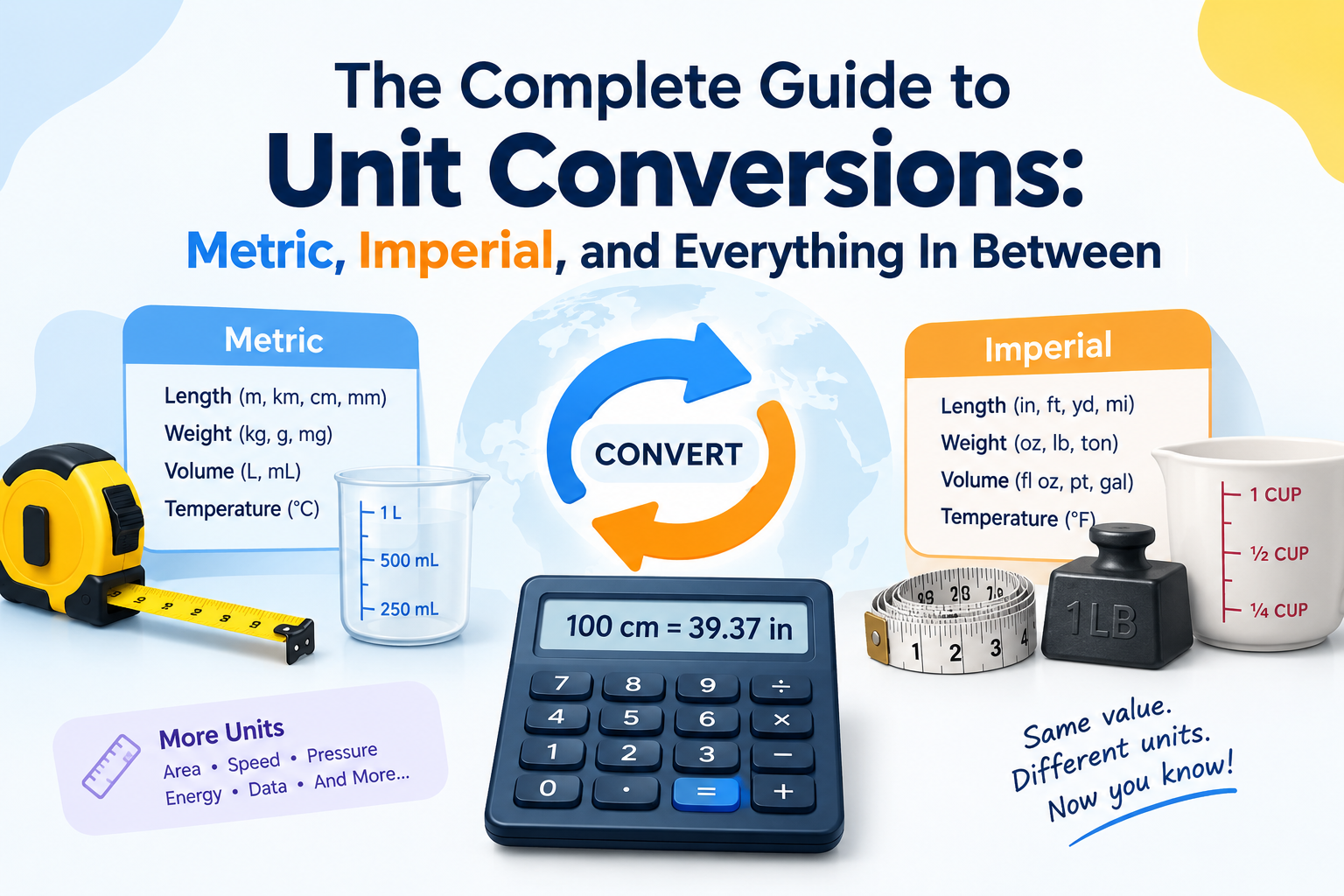
Ask ten people to convert 5 feet 10 inches into centimeters and you'll get ten different guesses — and at least three wrong ones. Unit conversion feels simple until you actually need an exact answer, and that's exactly the moment most of us reach for a search bar instead of doing long division on a napkin.
This guide walks through the systems behind everyday conversions, where people usually get tripped up, and which tool to reach for depending on what you're converting.
Why There Are Two Systems in the First Place
Most of the world uses the metric system — base-10 units like meters, grams, and liters that scale cleanly by powers of ten. The United States is one of the few countries that still runs primarily on the imperial system — feet, pounds, gallons — a patchwork of units that evolved from historical trade and craft standards rather than a single logical base.
Neither system is "wrong," but they don't talk to each other cleanly, which is why conversion errors are so common in cooking, construction, travel, and science.
In 1999, a NASA orbiter was lost because one engineering team used metric units and another used imperial — a $327 million reminder that conversions matter.
Length: The Most Common Conversion Headache
Length conversions come up constantly — furniture dimensions, travel distances, height, home improvement projects. The core relationships worth memorizing:
- 1 inch = 2.54 cm
- 1 foot = 0.3048 m
- 1 mile = 1.60934 km
For anything beyond quick mental math, a dedicated length converter handles the full range from millimeters to miles without rounding errors creeping in. If you're specifically going back and forth between centimeters and feet — a common one for height or furniture — there's also a centimeter-to-foot converter built just for that pair.
Temperature: Where the Math Actually Changes Shape
Temperature is the one conversion that isn't just multiplication — it involves an offset, which is why so many people get it wrong under pressure (pun intended).
- Celsius to Fahrenheit: (°C × 9/5) + 32
- Fahrenheit to Celsius: (°F − 32) × 5/9
Because the formula has that extra addition/subtraction step, it's easy to fumble when you're converting an oven temperature at 400°F while your recipe was written in Celsius. A temperature converter removes the risk of transposing the formula. If you're working with temperature differences rather than absolute readings — like a 10-degree swing in a lab result — note that's a different calculation, covered by the temperature interval converter.
Weight and Mass: Not Quite the Same Thing
Colloquially we use "weight" and "mass" interchangeably, but on Earth the distinction rarely matters for everyday purposes. What does matter is which unit system you're converting between:
- 1 kilogram = 2.20462 pounds
- 1 pound = 16 ounces
- 1 metric ton = 1,000 kg
Recipes, shipping labels, and gym equipment all mix these units depending on where they were made. A mass converter covers grams, kilograms, pounds, ounces, and stones in one place.
Volume: The Trickiest of All
Volume conversions are messy because "cup," "pint," and "gallon" mean different things depending on whether you're in the US or UK, and cooking adds a whole separate layer of small-volume units (teaspoons, tablespoons, drops). If you're converting a recipe:
- 1 US cup = 236.6 ml
- 1 US gallon = 3.785 liters
- 1 UK gallon = 4.546 liters (yes, they're different)
For general liquid and dry volume, use the volume converter. For kitchen-specific units like teaspoons, tablespoons, and cups, the cooking volume converter is built specifically around recipe conversions.
Speed, Area, and Pressure: The Ones People Forget Exist
A few conversions don't come up daily but matter a lot when they do:
- Speed — converting between mph, km/h, and knots matters for travel and weather reports. Try the speed converter.
- Area — square feet, square meters, and acres come up in real estate and land measurement. Use the area converter.
- Pressure — psi, bar, and pascals show up in tire inflation, weather, and engineering specs. The pressure converter covers all three plus more.
Digital Units: A Newer Kind of Conversion Confusion
Storage and data transfer units (MB, GB, TB, Mbps, MB/s) create their own confusion — partly because "1,000" and "1,024" are both used as the base depending on context, and partly because storage size and transfer speed use different units entirely (bytes vs. bits). A data storage converter and a data transfer rate converter each handle their respective side of that confusion.
A Quick Note on Precision
One thing worth understanding regardless of which converter you use: rounding behavior affects your result more than most people realize, especially when a conversion factor has a long decimal tail (like inches to centimeters). If you've ever wondered why two "correct" conversion tools give slightly different answers, our guide to calculator precision explains what's actually happening under the hood.
The Bottom Line
You don't need to memorize every conversion factor — you need to know which one applies to the problem in front of you, and trust that the tool doing the math is accurate to enough decimal places to matter. Browse the full converter library for anything not covered here, from angular velocity to voltage, or head to the calculators hub if what you actually need is a formula-based calculator rather than a straight unit conversion.