
Calorie Deficit for Weight Loss: How to Calculate Energy Balance, BMR & Sustainable Deficits
Learn how to calculate your exact daily calorie deficit for sustainable weight loss, adjust for metabolic adaptation, optimize macronutrients, and avoid common diet plateaus.
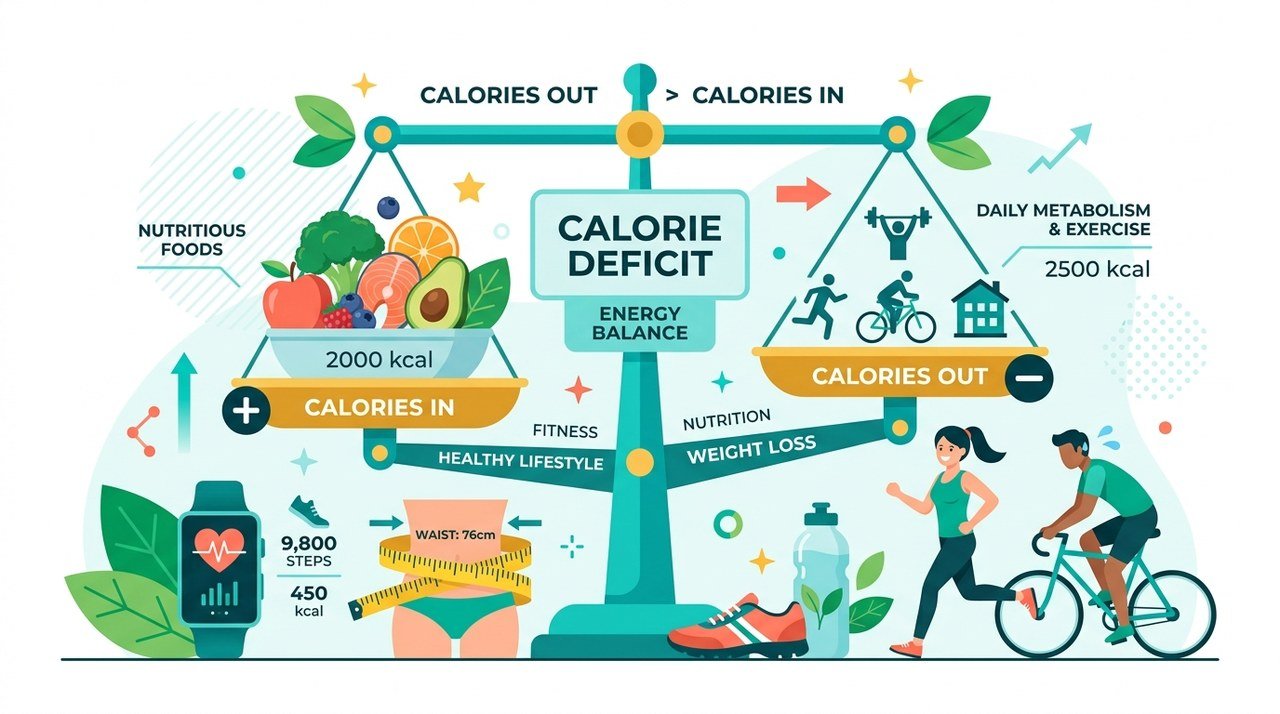
In the multi-billion-dollar fitness and diet industry, countless trends come and go — from ketogenic protocols and intermittent fasting to carnivore diets and meal-replacement shakes. Yet beneath every dietary framework that produces successful fat loss lies a single fundamental biological reality governed by the first law of thermodynamics: a sustained calorie deficit.
No matter the macronutrient distribution or timing of your meals, your body cannot lose adipose tissue without expending more energy than it consumes over time. However, simply saying "eat less and move more" overlooks the nuanced physiological mechanisms that regulate hunger, hormonal adaptation, and lean tissue preservation. Cutting calories too aggressively triggers severe metabolic downregulation, muscle wasting, and uncontrollable rebound bingeing. Conversely, an inadequate deficit can leave you frustrated on the scale for months.
In this scientific master guide, we break down exactly how to calculate your calorie deficit to lose weight with clinical precision. We walk through the gold-standard Mifflin-St Jeor formula, examine baseline metabolic rate versus total daily energy expenditure, discuss macronutrient partitioning, explore how low-intensity activity like walking preserves metabolic health, and demonstrate how to utilize our interactive Body Mass Index Calculator and companion tools on Convert & Count.
The Science of Energy Balance: Calories In vs. Calories Out (CICO)
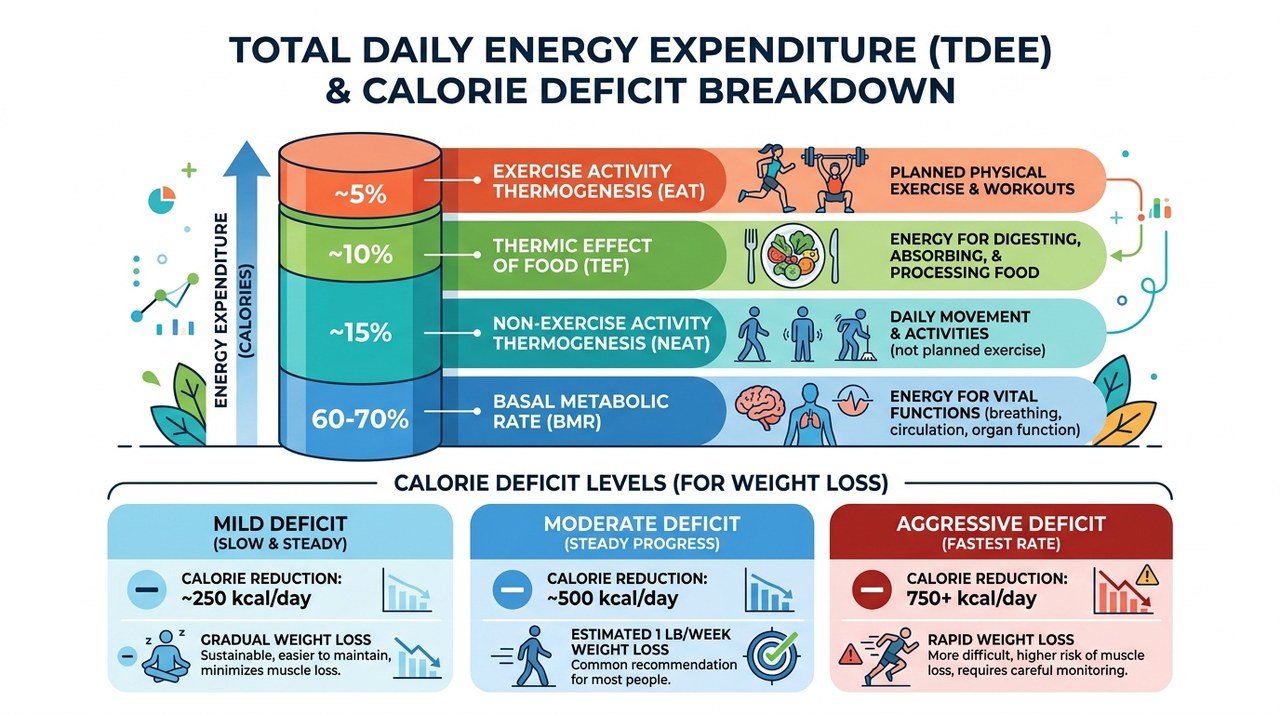
The human body functions as a biological heat engine. Energy intake arrives exclusively via chemical energy stored in food and beverages (macronutrients: carbohydrates, protein, dietary fats, and alcohol). Energy output, known as Total Daily Energy Expenditure (TDEE), is dissipated across four distinct physiological compartments:
- Basal Metabolic Rate (BMR): ~60% to 70% of TDEE
The baseline energy required to sustain vital cellular functions at complete rest in a post-absorptive state. This includes cellular respiration, brain function, cardiac output, renal filtration, hepatic synthesis, and core body temperature regulation. - Thermic Effect of Food (TEF): ~8% to 12% of TDEE
The metabolic cost of digesting, absorbing, metabolizing, and storing ingested nutrients. Protein exhibits the highest thermic effect (~20% to 30% of its caloric value), followed by carbohydrates (~5% to 10%) and dietary fats (~0% to 3%). - Non-Exercise Activity Thermogenesis (NEAT): ~15% to 25% of TDEE
Energy expended through all spontaneous physical activities outside structured athletic training. This includes walking to your car, climbing stairs, yard work, standing, gesturing, and fidgeting. NEAT is the single most variable component of daily human energy expenditure. - Exercise Activity Thermogenesis (EAT): ~5% to 10% of TDEE
Caloric energy burned during deliberate physical exercise, such as weightlifting, jogging, swimming, cycling, or high-intensity interval training (HIIT).
A true calorie deficit occurs when total caloric intake is less than the cumulative sum of BMR + TEF + NEAT + EAT:
Calorie Deficit = TDEE - Calorie Intake > 0
Wishnofsky's 3,500-Calorie Rule: Reality vs. Modern Nuance
In 1958, Dr. Max Wishnofsky published a landmark calculation in the American Journal of Clinical Nutrition asserting that one pound of human adipose tissue contains approximately 3,500 kilocalories of stored chemical energy (approximately 454 grams × 87% pure lipid content × 9 kcal/gram ≈ 3,555 kcal).
Historically, this gave rise to the universal clinical recommendation: "A daily deficit of 500 calories will yield exactly one pound of fat loss per week (500 kcal × 7 days = 3,500 kcal)."
While the 3,500-calorie heuristic serves as a helpful pedagogical starting point, modern mathematical modeling from the National Institutes of Health (NIH) emphasizes that human fat loss is dynamic rather than linear:
- As body mass decreases, your smaller body requires fewer calories to move and maintain itself, naturally lowering your BMR and NEAT.
- Adaptive thermogenesis reduces resting metabolic rate by an additional 50 to 150 kcal below predicted levels as a biological defense mechanism against starvation.
- Therefore, a static 500-calorie deficit produces rapid initial weight loss that gradually tapers into a stable equilibrium unless nutritional intake or activity is periodically recalibrated.
Step-by-Step: How to Calculate Your Maintenance Calories
Before establishing a target deficit, you must determine your baseline: what is my calorie maintenance? Follow this clinical 3-step calculation:
Step 1: Calculate Your Basal Metabolic Rate (BMR)
The Mifflin-St Jeor equation is recognized by the Academy of Nutrition and Dietetics as the most reliable predictive formula for non-obese and obese adults:
- For Men: BMR = (10 × weight in kg) + (6.25 × height in cm) - (5 × age in years) + 5
- For Women: BMR = (10 × weight in kg) + (6.25 × height in cm) - (5 × age in years) - 161
Example: Consider a 35-year-old male weighing 85 kg (187.4 lbs) with a height of 178 cm (5'10"):
- Weight component: 10 × 85 = 850
- Height component: 6.25 × 178 = 1,112.5
- Age component: 5 × 35 = 175
- Calculation: 850 + 1,112.5 - 175 + 5 = 1,792.5 kcal/day (BMR)
Step 2: Apply Your Physical Activity Multiplier (PAL)
Multiply your calculated BMR by the standard physical activity level multiplier that best describes your weekly routine:
- Sedentary (1.20): Desk job, minimal walking, no structured exercise.
- Lightly Active (1.375): Desk work plus light exercise 1 to 3 days per week or 6,000–8,000 daily steps.
- Moderately Active (1.55): Moderate exercise 3 to 5 days per week or 9,000–11,000 daily steps.
- Very Active (1.725): Hard exercise 6 to 7 days per week, physical labor occupation, or 13,000+ daily steps.
- Extremely Active (1.90): Twice-a-day rigorous athletic training, endurance sport, or military field operations.
Continuing our example for a moderately active individual: 1,792.5 kcal × 1.55 = 2,778 kcal/day (TDEE Maintenance). Consuming 2,778 calories daily will keep this individual's weight stable.
Step 3: Select Your Calorie Deficit Tier
Never reduce calories at random. Select a structured deficit tier tailored to your starting body composition and fat loss timeline:
- Conservative Deficit (10% to 15% below TDEE): Reduction of ~280 to 420 kcal/day. Best for athletes, lean individuals looking to drop the last few pounds, or those prone to diet fatigue. Fat loss: ~0.5 to 0.7 lbs per week.
- Moderate Deficit (20% to 25% below TDEE): Reduction of ~500 to 700 kcal/day. The gold standard for sustainable, healthy weight loss. Optimizes fat loss while sparing skeletal muscle tissue. Fat loss: ~1.0 to 1.5 lbs per week.
- Aggressive Deficit (30%+ below TDEE): Reductions of 800+ kcal/day. Only suitable for severely obese individuals under clinical supervision. In standard individuals, aggressive deficits trigger elevated cortisol, muscle atrophy, lethargy, and metabolic compensation.
For our example subject: a 20% deficit from 2,778 kcal yields an intake target of: 2,778 × 0.80 = 2,222 kcal/day (a daily deficit of 556 calories).
Macronutrient Distribution: Protecting Muscle During a Deficit
While caloric quantity dictates weight change, macronutrient composition dictates body composition change — whether the pounds lost come from subcutaneous fat stores or functional lean muscle tissue.
1. Dietary Protein (The Primary Priority)
When operating in an energy deficit, the body increases its rate of muscle protein breakdown for gluconeogenesis. Consuming adequate dietary protein stimulates muscle protein synthesis, preserving muscle mass even in an energy shortfall:
- Recommended Target: 0.8 to 1.1 grams per pound of total body weight (1.6 to 2.4 g/kg). If significantly overweight, calculate based on goal body weight or lean body mass.
- High Satiety Value: Protein stimulates the release of peptide YY (PYY) and glucagon-like peptide-1 (GLP-1) while blunting ghrelin (the hunger hormone), drastically reducing appetite during dieting.
- Thermic Effect: 25% of protein calories are burned purely during enzymatic digestion and urea cycle processing.
2. Dietary Fats (Hormonal Balance)
Fat is essential for lipid-soluble vitamin absorption (A, D, E, K), cell membrane integrity, and sex hormone synthesis (testosterone and estrogen):
- Recommended Target: 0.3 to 0.4 grams per pound of body weight (20% to 30% of total daily calorie intake).
- Never drop daily dietary fat intake below 15% of total calories or 35 grams for an extended period, as this can impair endocrine function, reduce thyroid hormone T3 conversion, and cause menstrual irregularities in women.
3. Carbohydrates (Fueling Performance)
After locking in protein and fat targets, assign all remaining calories to healthy carbohydrates (whole grains, oats, sweet potatoes, legumes, fruits, and fibrous vegetables):
- Carbohydrates replenish intramuscular glycogen stores, sustaining high workout intensity during resistance training.
- Fiber (aim for 25 to 35 grams daily) increases gastric distension, delays gastric emptying, and stabilizes postprandial blood glucose spikes.
The Role of Low-Intensity Movement: Why Walking Beats HIIT for Fat Loss
When dieters encounter a plateau, their instinct is often to add punishing cardiovascular sessions. However, excessive high-intensity interval training (HIIT) during a calorie deficit dramatically elevates systemic cortisol, increases joint strain, and triggers intense hunger spikes that derail nutritional compliance.
The superior alternative is increasing Non-Exercise Activity Thermogenesis (NEAT) through daily walking:
- Walking is a purely aerobic, low-impact activity that relies predominantly on free fatty acid oxidation rather than glycogen depletion.
- It creates a substantial caloric burn without driving compensatory hunger or interfering with muscular recovery from resistance workouts.
- Adding an extra 5,000 steps daily burns approximately 200 to 250 calories. Over one month, that equals 6,000 to 7,500 calories — translating to roughly 2 full pounds of pure fat loss without reducing food intake by a single bite!
To learn how your daily footstep count translates to distance, explore our in-depth Steps to Miles Conversion Guide or estimate workout energy expenditure with our Dog Walking Estimated Calories Calculator.
Metabolic Adaptation: Why Fat Loss Slows and How to Break Plateaus
Almost every dieter experiences a point where the scale stops moving despite adhering to the exact same calorie deficit. Understanding the biological mechanisms behind plateaus prevents premature panic and excessive calorie cuts:
1. The Adaptive Thermogenesis Cascade
The human body did not evolve in an environment of grocery stores and delivery apps; it evolved through severe famine cycles. Prolonged caloric restriction signals biological survival mechanisms:
- Circulating leptin (the satiety hormone) plummets by up to 50% within weeks.
- Thyroid hormone conversion of inactive T4 to active T3 slows down, reducing resting metabolic output.
- Subconscious NEAT drops automatically — you fidget less, sit more, blink slower, and adopt more energy-conservative movement patterns throughout the day without realizing it.
2. Fluid Retention Masking Fat Loss (Cortisol & Aldosterone)
Chronically elevated cortisol from dieting, intense training, and sleep deprivation causes the kidneys to retain sodium and water via increased aldosterone sensitivity. As adipocytes (fat cells) deplete their intracellular triglycerides, they temporarily absorb water, remaining the exact same physical size for days or weeks. When cortisol finally drops (often after a good night's sleep or a relaxing refeed day), the body releases this stored water in a phenomenon known in clinical practice as the "whoosh effect."
3. How to Overcome a True Plateau
If your scale weight has remained completely unchanged for 3 consecutive weeks, implement these systematic diagnostic steps:
- Audit Measurement Accuracy: Weigh all foods, dressings, cooking oils, and condiments on an electronic gram scale for 7 days. Most individuals unconsciously underestimate caloric intake by 20% to 40% when eyeballing portions.
- Check Step Volume: Verify that your daily step count has not drifted downward from subconscious fatigue.
- Implement a 48-Hour Refeed: Bring calories back up to maintenance for two days, specifically increasing complex carbohydrates. This temporarily boosts circulating leptin, refills glycogen, lowers cortisol, and flushes retained water.
- Adjust Deficit by 150–200 kcal: If accuracy and steps are confirmed, reduce daily calories by a modest 150 to 200 kcal, or add a 20-minute daily walk to reopen a 500-calorie deficit relative to your new, lighter body weight.
Full Worked Case Studies: Male vs. Female Calorie Deficit
Case Study 1: Moderate Weight Loss for an Adult Male
- Profile: 38 years old, 205 lbs (93 kg), 6'0" (183 cm), desk worker with 3 weekly gym workouts (Moderately Active, PAL = 1.55).
- Step 1 (BMR): (10 × 93) + (6.25 × 183) - (5 × 38) + 5 = 930 + 1,143.75 - 190 + 5 = 1,889 kcal/day.
- Step 2 (TDEE Maintenance): 1,889 × 1.55 = 2,928 kcal/day.
- Step 3 (20% Deficit Target): 2,928 × 0.80 = 2,342 kcal/day (586 kcal daily deficit).
- Macronutrient Targets:
- Protein: 190 g (760 kcal)
- Fat: 75 g (675 kcal)
- Carbohydrates: 227 g (908 kcal)
- Total Intake: 2,343 kcal
- Expected Outcome: 1.1 to 1.2 lbs of fat loss per week while maintaining strength in the gym.
Case Study 2: Sustainable Fat Loss for an Adult Female
- Profile: 31 years old, 155 lbs (70.3 kg), 5'5" (165 cm), sedentary office job with light weekend hiking (Lightly Active, PAL = 1.375).
- Step 1 (BMR): (10 × 70.3) + (6.25 × 165) - (5 × 31) - 161 = 703 + 1,031.25 - 155 - 161 = 1,418 kcal/day.
- Step 2 (TDEE Maintenance): 1,418 × 1.375 = 1,950 kcal/day.
- Step 3 (20% Deficit Target): 1,950 × 0.80 = 1,560 kcal/day (390 kcal daily deficit).
- Activity Boost: Adding a 30-minute daily walk (3,500 extra steps) burns an additional 150 kcal, expanding the total deficit to 540 kcal/day without reducing food intake below 1,560 kcal.
- Macronutrient Targets:
- Protein: 130 g (520 kcal)
- Fat: 50 g (450 kcal)
- Carbohydrates: 147 g (588 kcal)
- Total Intake: 1,558 kcal
- Expected Outcome: ~1.0 lb of pure fat loss per week with full energy for work and family life.
Common Mistakes to Avoid in a Calorie Deficit
- Cutting calories too low too soon: Dropping straight to 1,200 calories leaves you with nowhere to adjust when metabolic adaptation inevitably occurs 8 weeks later.
- Ignoring liquid calories: Specialty coffee drinks, sodas, alcohol, fruit juices, and energy drinks can easily add 300 to 500 uncounted calories daily.
- Failing to account for cooking oils: Pouring cooking oil into a pan without measuring adds ~120 calories per tablespoon. Two unmeasured tablespoons per day wipes out half of a 500-calorie deficit!
- Neglecting resistance training: Cardiovascular training alone without progressive resistance training signals the body that skeletal muscle is expendable, leading to a "skinny-fat" body composition.
- Bingeing on weekends: Being in a 500-calorie deficit Monday through Friday creates a 2,500-calorie buffer. Overeating by 1,300 calories on Saturday and Sunday completely erases the entire week's fat loss!
Frequently Asked Questions (FAQ)
What is the minimum safe daily calorie intake?
As a broad clinical guideline from the American College of Sports Medicine (ACSM), daily caloric intake should not drop below 1,200 calories per day for women and 1,500 calories per day for men without direct medical supervision, to ensure adequate micronutrient, electrolyte, and essential fatty acid intake.
Can I build muscle and lose fat in a calorie deficit at the same time?
Yes. This phenomenon, known as body recomposition, is readily achievable for individuals new to resistance training, those returning from a long layoff, and those with higher body fat percentages. It requires maintaining a modest deficit (10% to 15%), high protein intake (0.8–1.0 g/lb), and progressive overload in the gym.
How do I know if my calorie deficit is working?
Weigh yourself daily under identical conditions (morning, after using the bathroom, before eating or drinking). Calculate your 7-day rolling average. If the weekly average is trending downward by 0.5% to 1.0% of your total body weight each week, your calorie deficit is functioning perfectly.
Does eating late at night stop fat loss?
No. Total 24-hour energy balance determines fat loss. Eating carbohydrates or a meal at 9:00 PM does not inherently store fat if you remain within your daily deficit. However, late-night eating can occasionally disrupt sleep quality and increase next-day cravings.
How long should you stay in a calorie deficit?
Continuous dieting should generally be capped at 12 to 16 weeks. At that point, spending 2 to 4 weeks at maintenance calories (a "diet break") restores metabolic rate, normalizes leptin and thyroid hormones, and refreshes psychological discipline before starting another fat loss phase.
Summary & Key Takeaways
Achieving successful, lasting fat loss is not about starvation or extreme restriction — it is an exercise in applied mathematics and consistent behavioral execution:
- Determine BMR: Use Mifflin-St Jeor to establish baseline resting metabolic expenditure.
- Calculate TDEE: Multiply BMR by your true physical activity factor.
- Establish a 20% Deficit: Aim for a sustainable 500 to 700 kcal deficit to lose 1 to 1.5 lbs of fat per week.
- Prioritize Protein & Steps: Consume 0.8–1.0 g of protein per pound of body weight and walk 8,000 to 10,000 steps daily to preserve lean muscle and maximize energy expenditure.
Take the guesswork out of your health journey: check your baseline with our free Body Mass Index Calculator and start engineering your sustainable transformation today!